Jaime Levy – New Media Artist

Jaime Levy (b. 1966) is a Berlin-based new media artist working across video, experimental sound, and lecture-performance. Her practice encompasses custom-built audiovisual rigs for live signal processing, media-archaeological video works that reactivate obsolete digital formats and interface histories, and performative lectures tracing the transformation of intermedia and early cyberculture into contemporary mediated experience.

Levy began her career in the late 1980s experimenting with video art, and gained recognition for her groundbreaking floppy-disk “electronic magazines,” created while a graduate student at NYU’s Interactive Telecommunications Program. Her Cyber Rag series (1990) fused animation, sound sampling, and interactive games, making digital publishing accessible at a moment when personal-computer interactivity was still largely unimaginable. She later created Ambulance, an interactive horror e-book featuring music by Mike Watt and artwork by Jaime Hernandez (Love and Rockets), and produced the first major-label interactive press kit for Billy Idol’s Cyberpunk, distributed internationally. These works positioned Levy at the forefront of multimedia practice, merging pop culture with nascent digital media.

Throughout the 1990s, she developed Malice Palace, a virtual world integrating real-time chat, 3D environments, and DJ Spooky’s sound samples, and served as creative director of WORD.com, one of the earliest web magazines to push the boundaries of interface design and narrative form. In the 2000s, Levy shifted toward user experience strategy, drawing on her background in experimental product creation to advise entertainment and technology companies. This trajectory culminated in her best-selling book UX Strategy, translated into nine languages and widely regarded as a foundational text in the field. She continues to lecture internationally on strategy, innovation, and the history of new media.

Jaime Levy Art CV

Recent Performances

January 22, 2026 – Vorspiel / Transmediale
TVOD: Live TV Signal Processing — Electronic Music & AI Visuals
https://youtu.be/rtZzv6uJvR8?si=6XIBeM9is6lXfhWr
A fully musical performance using live TV signals and sampling to create improvised electronic music, accompanied by AI-driven visual effects.

 January 29, 2026 – Vorspiel / Transmediale
Lecture Performance: Jaime Levy — Live TV Signal Processing + AI
https://youtu.be/2TBDCU9lG8s?si=taByd-C52jxKkBMN
This version begins with a six-minute lecture outlining the conceptual and technical framework of the work, followed by six minutes of live performance.

Jaime Levy Retrospective
of New Media Art 1990 – 2000

“Computer technology has revolutionized the production of independent art. There are new worlds to explore; such as the possibilities of electronic publishing using personal computers not just to create words and pictures, but to disseminate them in formats that keep them alive and dynamic… as opposed to the frozen quality of ink on paper.”
– Jaime Levy 1990

Cyber Rag

The first edition of “Cyber Rag” was made in HyperCard and is a floppy disk filled with bizarre pictures, sound, animation and words. It includes two animated sequences and some nasty still images complemented by industrial sounds. Three games including a brief quiz on the computer mogul Steve Jobs. Plus two pieces of hacker poetry. (N.Y.C. 1990)

Cyber Rag 2

was also made in HyperCard and includes two animations and an interactive advertisement. Two games include a graffiti Cher’s face paintbox and a Concentration test of animated icons. It is tighter and cleaner than the first with more relevant information about current technology including a review of a Timothy Leary show. (S.F. 1990)

Cyber Rag 3

rules all three in terms of content, but only works well on a Mac with at least three megs of RAM. It is a self-contained with its own projector because it was programmed in MacroMind Director. It includes animated poems, a bitchy editorial, samples, and three trade shows including Cyberthon, CyberArts, and Virtual Reality 1990. (S.F. 1991)
Video clips: 1, 2.

Electronic Hollywood

is the new Cyber Rag covering events and experiences that happen in Los Angeles. Like Cyber Rag 3, it is programmed in MacroMind Director “Lingo” plus a color interface screen. Includes reviews about Techno House Raves, Siggraph, Intertainment 91, and a Greater Bay Area dis. (L.A. 1991)

Electronic Hollywood II

is the latest Digital Riot issue. Has the same color interface design of the first Electronic Hollywood, but more slick digitized images. It contains the usual hateful editorial, reviews of the L.A. riot, Verbum, Human Be-In S.F., and Home Media Expo in L.A. Plus samples and reviews from 2 great California bands: Ethyl Meatplow and The Disposable Heroes of Hypocrisy. (L.A. 1992)

Threat Man

is a presentation animation featuring color cycling. The cycling creates illusions of movement turning a static painting into a more dynamic visual effect. It is a basic digital representation of an acid trip. Requires a Macintosh with a 13″ color monitor and no drugs. (S.F. 1991)

Ambulance

is the sound-tracked horror story on a 1.4MB floppy of five L.A. post-collegiate 20-something posers. Featuring sequenced samples by Mike Watt (Minute Men) and digitized art by Jaime Hernandez (Love and Rockets comic book series). Click on the interactive animations and hypertext hotspots. Plays on all Macs. No skills required. (L.A. 1993)

Billy Idol’s CyberPunk

is my first sell-out software! Regardless of whether you like Billy Idol or not, this 1.4MB disk is a hardcore exploitation of presentation media-turn-interactive-MTV. It has the infamous Electronic Hollywood II interface design, but Billy art from his music videos and Billy sample loops from his latest release. This is the first floppy ever distributed with an album.  (L.A. 1993)

Malice Place

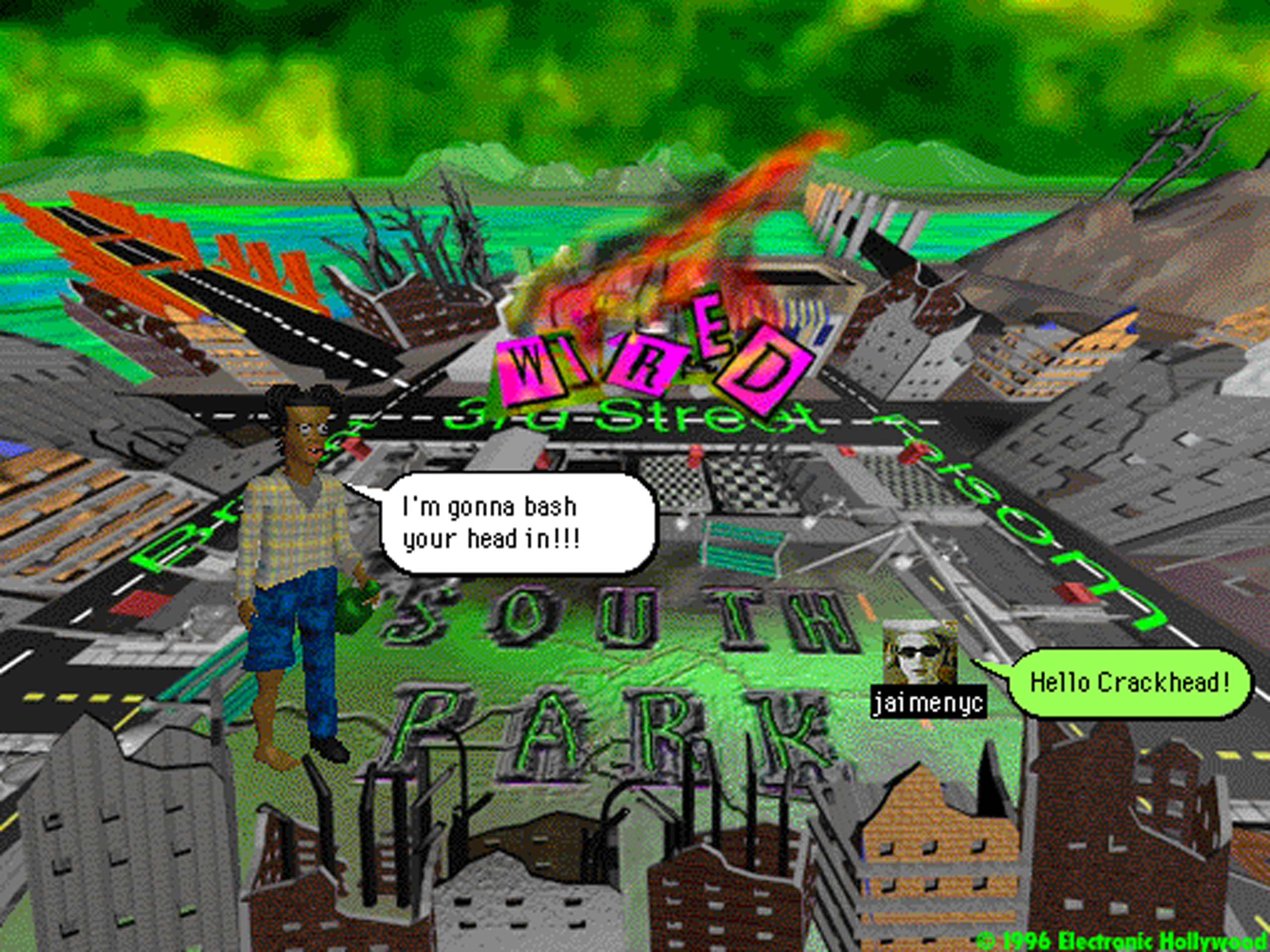
A virtual world built with The Palace software which combined real-time chat, 3D art, and DJ Spooky sound samples to fuse societal commentary with early multi-user environments. Set in a post-apocalyptic San Francisco, it invited users to converse and interact with scripted robot characters portrayed as drug dealers and street people. Prints from Malice Palace were later shown in the 1998 group exhibition Channel 3 at Team Gallery in New York, alongside works by Tracey Emin. (N.Y.C. 1996)

SELECTED PRESS, PUBLICATIONS & DOCUMENTARY FEATURES

High Performance. “Jaime Levy: Cyber Rag” 1990
Mondo 2000. “Jaime Levy’s Pioneering Electronic Magazines” 1992
The New York Times Book Review. “And Now, Boot Up the Reviews” 1993
The Boston Globe. “Billy Idol Turns Cyberpunk on New CD” 1993
PBS. “Life and Times” 1993
Los Angeles Times Magazine. “Hack Attack: Thoroughly Modern Mag” 1994
New York Magazine. “IBM’s CyberSlacker” 1994
Harper’s Bazaar. “These Women Do Not Fear The 21st Century” 1995
Newsweek. “50 for the Future” 1995
The New York Times. “So What’s A Web Browser, Anyway?” 1995
Village Voice. “Star Search” 1998
Home Page, directed by Doug Block 1999
Der Spiegel. “Internet: Genies im Groessenwahn” 1999
New York Magazine. “Cover Story: Generation 1.0 – Silicon Alley Veterans Tell All” 2000
The New Yorker. “Day Job: Web Content Producer” 2000
Dateline NBC. “Can You Be a Millionaire?” 2000
Gig: Americans Talk About Their Jobs, pp. 364–369 2001
Silicon Alley: The Rise and Fall of a New Media District 2004
Hackers & Slackers: NY New Media Underground in the Early 1990s 2012
Totally Wired: On the Trail of the Great Dot-com Swindle 2012
Broad Band: The Untold Story of the Women Who Made the Internet 2018
New York Magazine. “The Untold Story of Jaime Levy” 2019
AIGA Eye on Design. “Multimedia Artist Jaime Levy was at the Forefront” 2020

Articles and media available at:
www.jaimelevy.com/about